And why it’s changing the future of workplace support
If you work in IT, HR, Facilities, or any business function that runs on service requests, you’ve probably noticed a major shift over the last few years: employees don’t want to leave Microsoft Teams to get help anymore. They don’t want to log in to a portal, hunt for a form, or remember which department owns which type of request. If they have a question, they go straight to Teams—because it’s already open, already familiar, and already central to how they work.
This shift isn’t a trend. It’s the new norm. And increasingly, organizations are treating Microsoft Teams as their frontline helpdesk interface—not just for IT tickets, but for a variety of service functions across the business.
Here’s why.
1. Teams is where employees already spend their time
Today’s digital workplace revolves around Teams. Whether employees are chatting, meeting, collaborating on documents, or sharing updates, Teams is the screen that never closes.
This is important, because the biggest obstacle to an effective helpdesk isn’t the quality of your service—it’s adoption. Even the best-designed portals often go unused simply because they’re not part of an employee’s daily workflow.
Teams changes that.
When the service experience is embedded directly into the platform people already use, the barriers to entry disappear. Submitting a request becomes as natural as sending a message. Asking for help doesn’t require navigating to another website or remembering a long URL. Teams removes friction—and friction is what kills helpdesk adoption.
2. The helpdesk becomes conversational, not transactional
Traditional ticketing systems force users into rigid forms and workflows. But the way people actually ask for help is conversational.
“I can’t log in.”
“My laptop is acting weird.”
“I need a copy of that HR policy.”
“Can someone approve this for me?”
With Teams, support starts where the question starts—inside a chat.
Instead of routing users away from the conversation to a portal, the helpdesk experience now lives inside the conversation itself. That’s a huge upgrade in usability. And for IT and service teams, it dramatically improves the quality of initial information captured, because they can convert the real context of the message into a structured ticket.
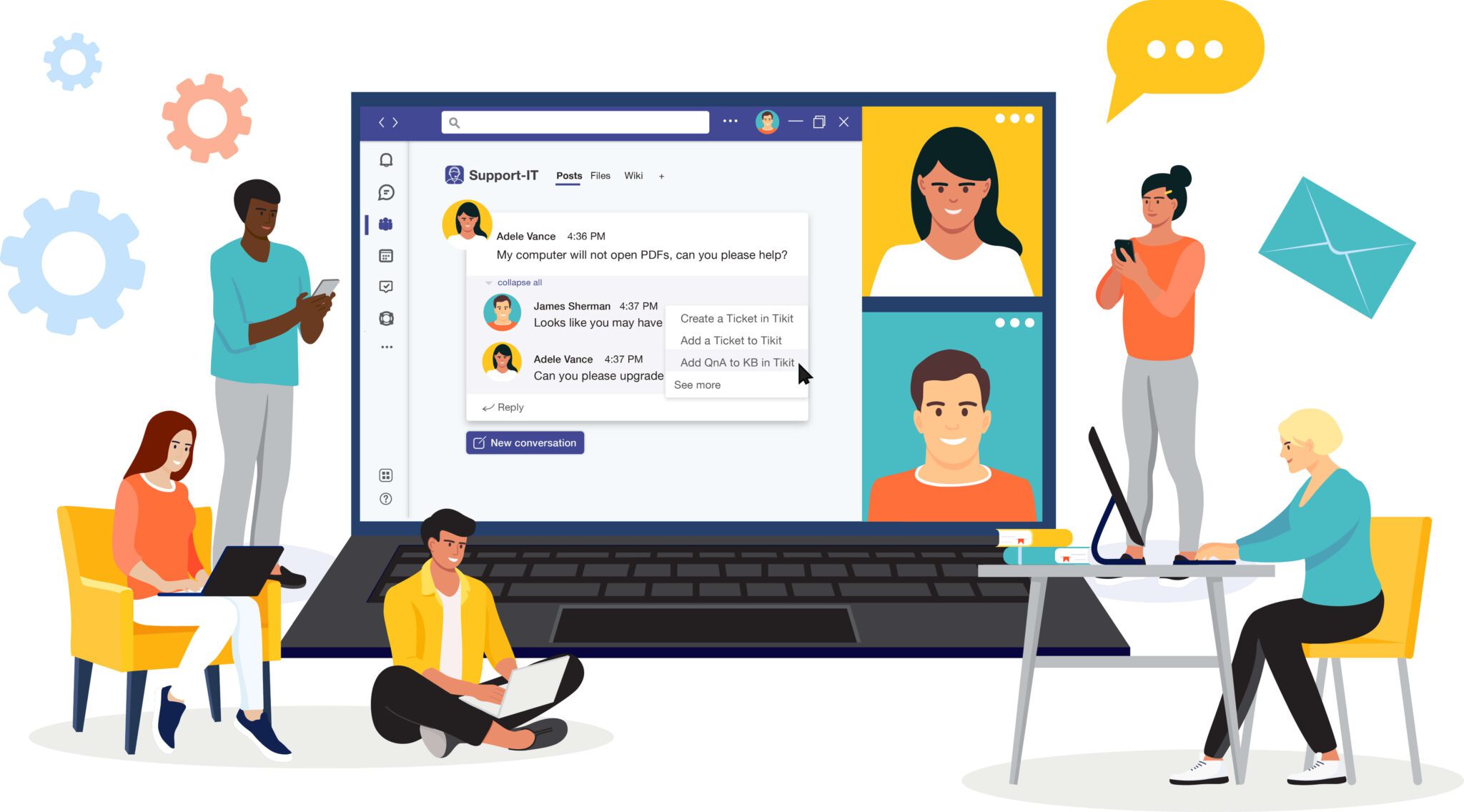
Some tools—like Tikit by Cireson, built natively in Teams—take this even further by allowing you to right-click a message and create a ticket automatically. No copying, pasting, summarizing, or interpretation required. The conversation becomes the request.
This conversational interface isn’t just convenient. It’s a better reflection of how modern teams work.
3. It reduces the “shadow helpdesk” happening in chats and emails
Every helpdesk manager knows this pain: your official ticket volume says one thing, but your real workload tells another story.
The culprit?
Side conversations, hallway chats, direct messages, emails—aka the “shadow helpdesk.”
This happens when your official support channel feels like too much effort. If users think it’s easier to message a technician or friend directly, they will. But that means:
- Work isn’t tracked
- Work isn’t prioritized
- Work isn’t visible
- And staff get overwhelmed
By contrast, when Teams is the helpdesk interface, those side conversations transform into trackable, reportable requests. Support staff don’t have to police people into using a portal—they simply meet them where they are.
Tools built specifically for Teams-based service management make this seamless, creating a formal ticket from an informal conversation and ensuring every request is captured. And with Tikit’s Group Chat feature, those side conversations are forever linked to the ticket, easily referenceable at any time in a place that keeps the activity log clean.
4. It shortens resolution time
Support teams live in Teams too. They’re already answering questions, monitoring channels, collaborating, and solving problems. When both the request and the response happen in the same platform:
- Technicians get visibility faster
- Users get updates instantly
- Approvals move quicker
- Handoffs are streamlined
Plus, Teams’ integrated notifications ensure no one misses an update buried in a portal or email thread.
Some organizations adopting a Teams-first helpdesk even see their average time-to-resolution shrink simply because the back-and-forth becomes easier and more natural.
5. Teams is now part of the IT strategy—not just communication
Microsoft has steadily invested in Teams as the operating layer for the digital workplace. With AI capabilities, workflow automation, deep integration into Microsoft 365, and countless business apps embedded right inside Teams, it’s becoming more than a communication tool.
It’s becoming the control center for work.
For service desks, that means Teams isn’t a bolt-on layer—it’s a platform built to support workflow, knowledge, automation, and service delivery.
Teams-native solutions like Tikit are leveraging Power Automate, adaptive cards, approvals, bots, and M365 connectivity to create extremely powerful service experiences that would’ve required custom development just a few years ago.
Put simply: the ecosystem has matured. And the helpdesk is benefiting.
6. It unifies service delivery across departments
One of the biggest frustrations for employees is not knowing where to go for help. Is this an IT request? HR? Facilities? Finance?
When Teams is the entry point, users don’t need to know.
They just start the conversation. The system routes it.
Organizations are using Teams as the universal frontline for:
- IT service management
- HR support
- Facilities requests
- Onboarding/offboarding
- Access management
- Procurement
- Legal and compliance inquiries
- Marketing requests
- And more
This unifies the experience, eliminates guesswork, and makes service delivery feel seamless—no matter who owns the request behind the scenes.
Why Tikit Matters in This New Landscape
As companies embrace this shift, many realize they need more than a traditional ticketing tool—they need a solution that was built for Teams from day one.
That’s where Tikit fits in.
Tikit by Cireson is fully embedded in Microsoft Teams, designed to turn chats into tickets, automate workflows, streamline approvals, and help every department deliver support without forcing employees into another system. It’s lightweight, modern, and leverages all the Microsoft 365 power organizations already invest in.
You don’t have to change user behavior.
You don’t have to retrain the company.
You don’t have to introduce a new interface.
You simply bring service management to the place people already work.
The Bottom Line
Microsoft Teams has become the new helpdesk interface because it solves the biggest problem in service delivery: making it effortless for employees to get help.
When support begins inside Teams, organizations see:
- Higher adoption
- More complete ticket data
- Faster resolutions
- Better visibility
- Stronger cross-department collaboration
- A more modern service experience
Whether you run IT, HR, Facilities, Finance, Marketing, or a shared services model, Teams-based service delivery is no longer optional—it’s the new expectation.
And solutions built for this world, like Tikit, make the transition simple, intuitive, and incredibly effective.
Tikit is a Microsoft 365 IT Service Management (ITSM) platform built to mature alongside your M365 adoption and bring service delivery directly into Teams. Want to learn more about Tikit and how it simplifies Teams-based ticketing and IT support? Check out our demo video and try Tikit in a 14-day free trial. We are so confident in Tikit’s capabilities that we’ll even set it up for free to ensure you get the most out of your Microsoft Teams ticketing experience. Schedule your complimentary setup call today.